Crystal Types
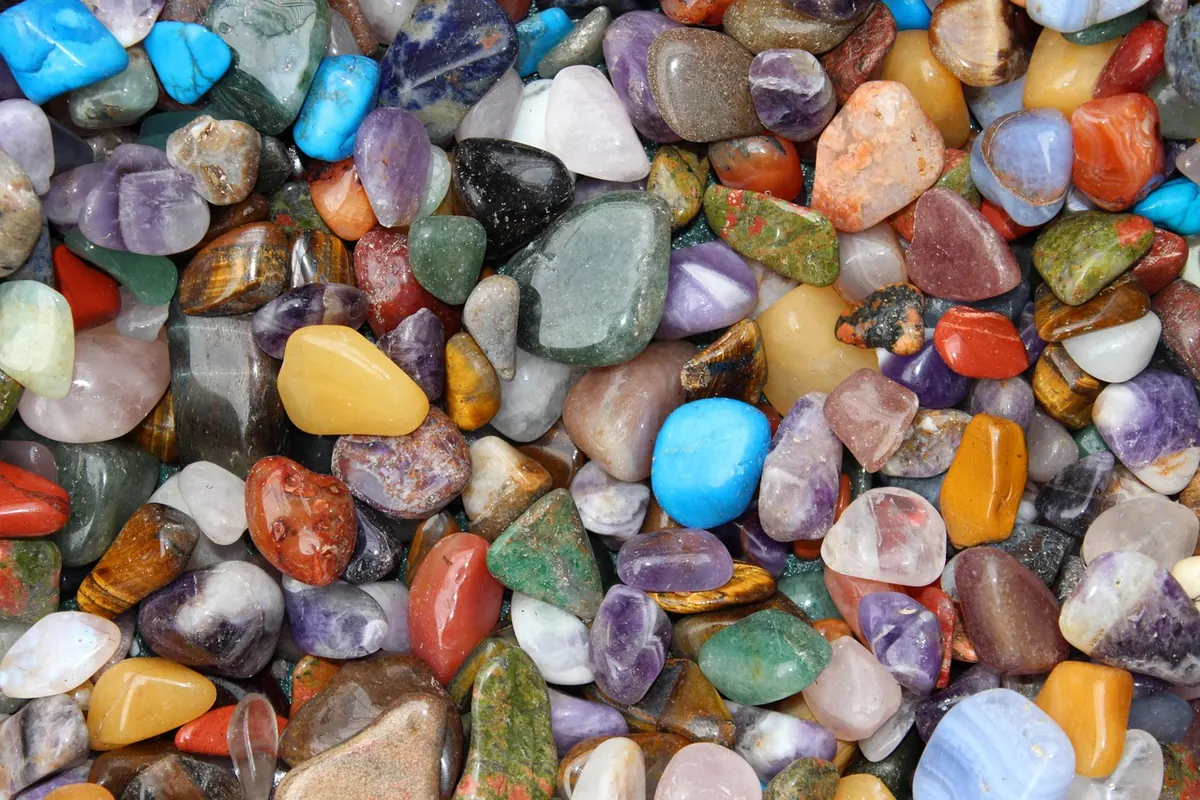
A Beginner's Guide to the Quartz Family: 12 Varieties and How to Tell Them Apart
Quartz is the mineral most people meet first and recognise last. It is in the sand underfoot, in the gravel on a driveway, in the pale point on a windowsill that nobody remembers buying. One lump of silicon dioxide can be water-clear, milky, pink, smoky, purple or orange, and every one of those is still quartz. The variety names describe what colour or inclusion has happened to it, not a different mineral. Learn a dozen of those names and a handful of physical habits, and the family stops looking like a crowd and starts looking like a set of relatives.
The shared fingerprint of quartz
Before the colours, the constants. Four habits give quartz away whatever its tint.
It is hard — seven on the Mohs scale — so a sharp edge will scratch ordinary glass, while a fingernail and a copper coin will not touch it. A steel knife blade, at roughly five and a half, slides across a quartz face without leaving a mark; that single test separates quartz from calcite, gypsum and most of the soft impostors in a beginner's tray. It has no cleavage: it does not split along flat planes, and a broken surface is curved, glassy and shell-like, with ripples that fan out from the point of impact. Left to grow freely, it builds six-sided prisms topped by pyramids, and the prism faces usually carry faint horizontal striations — fine parallel lines running across the face rather than along it. And its streak, the powder left when you rub it across unglazed porcelain, is white.
Those rules hold for a beach pebble and a museum specimen alike. A quartz point that has been tumbled smooth still scratches glass; a quartz pebble from a river bank still leaves a white streak; a broken quartz chunk still shows that curved, glassy fracture rather than a flat, stepped plane.
Scratch test, streak test, fracture test. Three checks, two minutes, and most of the quartz family has already introduced itself.
Clear and milky: the plain-spoken pair
Clear quartz, usually sold as rock crystal, is the reference point for everything else. Good pieces are transparent enough to read through, though most carry faint veils, tiny bubbles or cracks that catch the light. It grows in points, in masses, and in the long wands that turn up at every mineral fair. Because it is colourless, it is also the variety most often imitated in glass. Look for perfectly round, isolated bubbles sitting in clear material — those usually mean glass. Quartz inclusions tend to be flat, angular or strung along growth lines.
Milky quartz is the quiet cousin: white, cloudy, translucent to nearly opaque. The cloudiness comes from countless microscopic fluid-filled cavities trapped as the crystal grew. It usually appears as massive veins rather than formed points, which is why most milky quartz you find is a tumbled lump with no faces at all. Hold a thin slice to a lamp and you will often see faint banding or a soft glow through the edges. Much of it is the gangue — the waste mineral — of old metal mines, which is why milky quartz lumps so often come with a crust of rust or a smear of green copper stain.
The coloured family
Rose quartz
Rose quartz is pink, and almost always massive — smooth lumps and cabochons far more often than crystals with faces. The colour is usually soft, slightly cloudy and uneven, and it can fade with long exposure to strong sunlight. Good material comes from Madagascar, Brazil and the Black Hills of South Dakota, and a few pieces show a six-rayed star when cut as a dome; that star is the reflection of thousands of microscopic rutile fibres aligned inside the stone. A warning sign for dyed material: intense pink that pools in cracks and looks stronger in the damage than in the body of the stone.
Smoky quartz
Smoky quartz runs from pale taupe to deep brown, and the darkest material, called morion, looks almost black in the hand. Turn a piece slowly in front of a bright lamp and the tone shifts as the light passes in different directions — that changing depth is one of the easiest checks. Natural smoky quartz also shows colour zoning, lighter near the base and richer toward the tip. The colour comes from tiny traces of aluminium that have been nudged by natural radiation over geological time, which is why it turns up in granite pegmatites alongside radioactive minerals. Historic Cairngorm stones from Scotland, set into kilt pins and shoulder brooches, are smoky quartz. A great deal of grey-brown quartz on the market is heat-treated amethyst, which tends to look flatter and more uniformly grey.
Amethyst
Amethyst is purple, and its colour is rarely even. Expect a paler core, a richer tip, or bands running parallel to the crystal faces. In strong light you can often catch flashes of red and blue as the stone moves. Natural amethyst frequently grows with a white quartz rind and a clear zone near the base, and that layered look is hard to fake convincingly. Big cathedral geodes from Brazil and Uruguay, split open to show a cave of purple points, are the classic collector's piece, and the finest colour still tends to sit in the tips. Amethyst also grows as sceptres, where a second, larger crystal has formed on the shoulders of an earlier one.
Citrine and prasiolite
Natural citrine is uncommon. Most yellow-orange quartz sold today is amethyst that has been heat-treated, an old and widely accepted trade practice. The clue is inherited structure: heated citrine often keeps amethyst's zoning, with a strong orange tip over a pale body and sometimes a reddish cast in the depths. Natural citrine tends toward a paler lemon or honey tone, often with a faint smokiness. The deep amber material sold as Madeira citrine is usually heated amethyst as well. Prasiolite, the pale green variety, is generally heat-treated amethyst too, or amethyst that has been irradiated. Buyers who care about natural colour should ask directly, and expect a straight answer.
Quartz with guests inside: rutile and tourmaline
Rutilated quartz holds fine golden needles of rutile suspended in clear quartz. They read as straw, hair or a spray of threads, from a few lonely strands to dense tangles that fill the whole stone. The needles are hair-fine, often slightly curved, and usually gold to coppery in colour; in some stones they are dense enough to give the quartz a soft, satiny sheen.
Tourmalinated quartz holds black needles of schorl, which are thicker, straighter and blunter, often crossing each other in bundles. Where a needle sits, you will sometimes see a small milky halo or a dark shadow in the surrounding quartz. The practical difference is simple: gold and hair-fine means rutile, black and rod-like means tourmaline. Both are still quartz, so the same hardness and fracture rules apply. When a lapidary cuts one of these stones, the needles are usually aligned across the face of the cabochon so the light catches them all at once.
Growth stories you can see: phantoms, Herkimers and fire quartz
Phantom quartz records a pause. The crystal stopped growing, collected a dusting of chlorite or iron, then carried on — leaving the outline of an earlier crystal trapped inside. The ghost layer repeats the crystal's own shape, sometimes in green, sometimes in red or grey, and a really good specimen shows several nested outlines like a set of nested cups. A random cloud is not a phantom; a small crystal-shaped boundary is.
Herkimer diamonds are small, doubly terminated, water-clear quartz crystals, named for the region around Herkimer, New York, where they weather out of a dolostone. The name is marketing, not mineralogy — they are quartz, not diamond, though their brightness and sharp terminations explain the nickname. Most are under three centimetres, many carry black flecks of solid hydrocarbon inside, and good ones are prized because they sit loose in the clay and come out already clean, with points at both ends and no broken base.
Fire quartz is clear to milky quartz shot through with thin plates and flakes of red-brown hematite or goethite. Held to the light, those plates flash copper and orange, which is where the name comes from; dealers sometimes call it fire-and-ice quartz or hematoid quartz. The inclusions usually lie in flat, parallel layers, so a cut stone can look almost banded, and the flashes move as you turn it.
A five-minute test routine
Set a doubtful stone on a dark cloth under a bright lamp and work through the same steps every time.
- Look at the shape. Six-sided prisms, pyramid tips and fine horizontal striations on the prism faces all point to quartz.
- Check the break. Curved, glassy, shell-like fractures mean no cleavage; flat, stepped or pearly planes mean you are probably looking at something else.
- Test the hardness. Scratch a piece of ordinary glass in an inconspicuous place. Quartz wins; glass, lead crystal and most fakes lose.
- Take a streak. Rub the specimen on the back of a white tile. A white powder supports quartz; a coloured streak usually rules it out.
- Hunt for bubbles. Perfectly round, isolated bubbles in clear material suggest glass. Flat, angular or line-following inclusions suggest natural quartz.
- Ask about treatment. Heat treatment and irradiation are routine and legal. Knowing which is which explains the price and the colour.
The cryptocrystalline cousins: agate, jasper and chert
One more thing is worth knowing early, because it confuses more beginners than any single variety. Agate, jasper, chert, flint, onyx and carnelian are all quartz as well — the same silicon dioxide, but grown as microscopic fibres rather than big crystals. Geologists call this material chalcedony, and it shares quartz's hardness of seven and its white streak, so it scratches glass just as readily. What it lacks is crystal faces.
That difference is easy to see once you know what to look for. Agate shows curved, concentric banding and a waxy, slightly greasy lustre, and thin slices glow at the edges when held to a lamp. Jasper is opaque and thoroughly coloured by iron, often red, yellow or green, and breaks into smooth blocks. Chert and flint are the grey, dull, splintery versions that turn up in field walls and old tool kits. So a box of "quartz" can contain both a perfect six-sided point and a banded pebble with no geometry at all, and both answers are correct.
Twelve names, one mineral, and a short list of habits that never change. Once the hardness, the fracture, the streak and the crystal form are familiar, the colours become a matter of curiosity rather than confusion — and that pale point on the windowsill finally gets a proper name.
Photo: Aldk / Pixabay
Related Articles